Local basketball doing well in bringing home state title hardware:
Three state titles have been claimed since the 2022 AHSAA season:
GDW Analysis:
BIRMINGHAM: A solid pattern by local basketball has been created with very good success in the last 5 years,
AHSAA championships have been claimed by the Cullman Bearcats and the Good Hope Lady Raiders with a couple of runners up being earned in this span by the Cold Springs Lady Eagles.
The 2026 season is now done with three locals sharing the spotlight for playing in their state title game in their respective class.
Good Hope had the best of the final result with victory in Class 4A against Plainview on March 6 from Legacy Arena.
Cold Springs and Cullman challenged but were not able to be on top when time ran out.
Cold Springs fell to North Sand Mountain in the 2A girls' championship Friday morning.
Cullman went down to defeat against Oxford in the 6A championship Saturday afternoon.
All three had the enduring task of playing a school ranked No. 1 in their classification by the and state sportswriters prior to the playoff run.
These three have put together a lot of work in this span and no doubt the honors they have gained from it will linger in their hearts and souls for plenty of time down the road.
In 5 years with Cullman basketball, Stu Stuedeman has made a tremendous impact by leading the team to 131 victories and only 29 losses.
The winning percentage in this span for the Bearcats is .818.
Justin Aby at Good Hope has built the Lady Raiders to a solid contender for three consecutive trips to the 4A championship round. They have earned the blue trophy in 2024 and 2026.
Victory in now the completed season allows Aby and his squad to lay to rest the tough time they experienced in the 2025 championship game loss to Trinity Presbyterian of Montgomery.
Cold Springs' Lady Eagles have enjoyed playing in the Final Four three of the last four years.
The only change for this group in 2026 was from the top with Paige Adams now the head coach. Tammy West was courted to go to Cullman after 2025 when the Lady Eagles were an Elite Eight in Class 2A.
Adams accomplished so much in her first season coaching at her alma mater for 23 victories in 34 games, a solid playoff run that put them into the state championship with a new squad in 2A on the rise in North Sand Mountain.
A very good season of local hoops:
It is indeed the best season of local basketball that Gameday Weekly has been a part of for the fact of three schools reaching the state championship and others displaying success in their own version.
From the varsity, Cullman's 27 & 6 record is 2nd best this year to a fine 29 & 5 season that Cold Springs accomplished with Drew Adams in command after coaching greatness for 9 years at Good Hope with 186 victories.
West Point went 23 & 9 that got the Warriors to the sub regional round before being ousted by Boaz.
The three combined to go 79 & 20, taking victory 79 percent of the time.
For girls' basketball, five squads out of the Cullman County system qualified for the sub regional round. That would set a great trend for 13 wins in 17 playoff decisions would be the result for this segment of the
postseason.
Good Hope would be at the top for a 5 & 0 record with Cold Springs 4 & 1. West Point had 2 victories with wins being recorded by Vinemont and Holly Pond in the sub regional.
No other county sent as many girls' teams this deep into the 2026 postseason as Cullman County.
Four of these five produced 22 wins in the calendar year or better. Good Hope finished at 30 & 6 and is 91 & 14 in the past three years.
So, we say goodbye to an incredible playoff journey and salute those who gave us plenty to be proud of for the continued growth of local basketball in its association with the AHSAA.
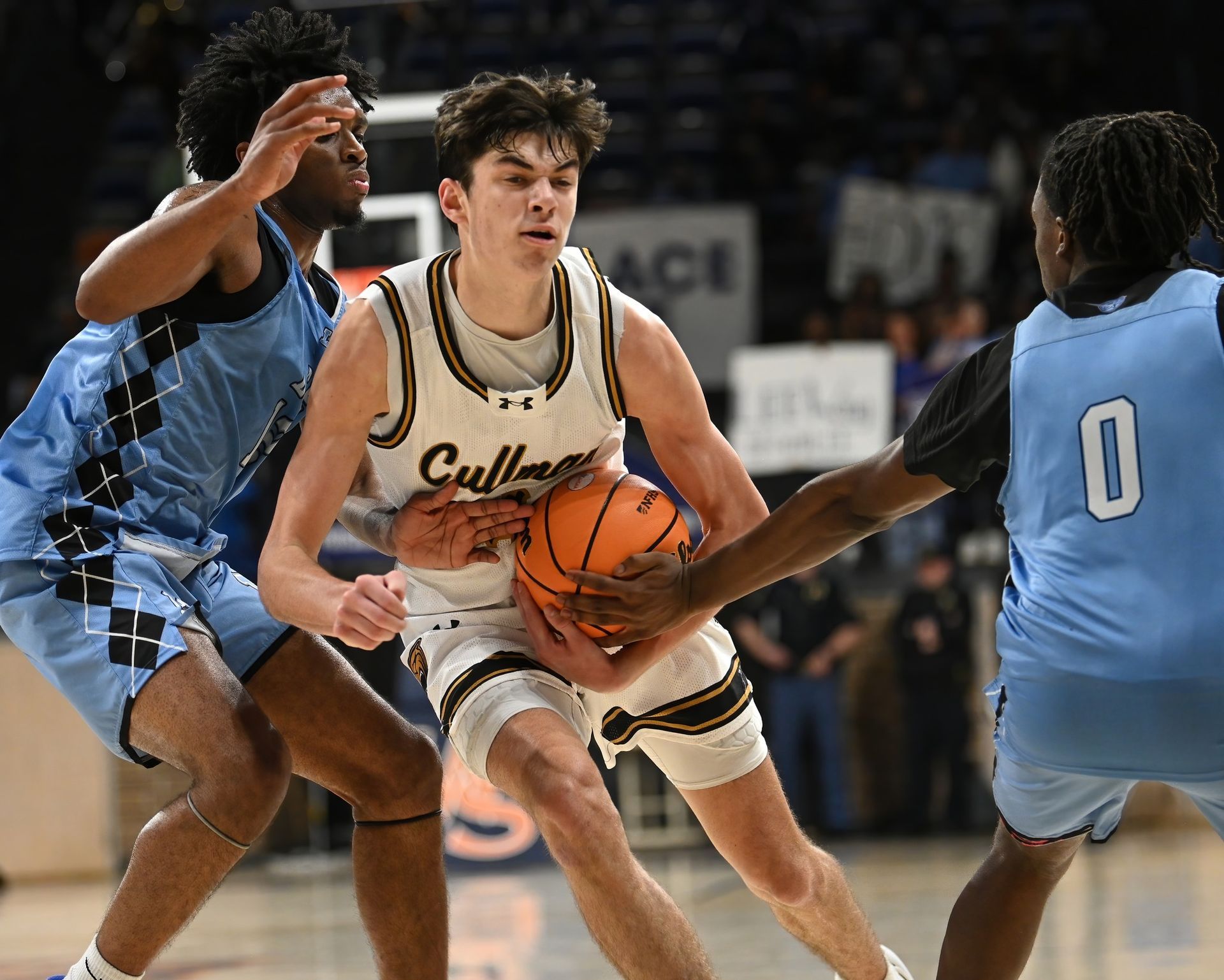
Photo of Cullman Bearcats' Sam Dorough going up against Lee Huntsville defenders in the Northwest Regional 6A championship from Wallace State CC February 24.
Photo courtesy of Martha Needham.